From reference motion to the real robot
One motion, three stages: the retargeted reference motion, the trained controller in simulation, and the same controller on the AgiBot X2 Ultra. Source motion: BonesSeed relaxed walk motion.
1Overview
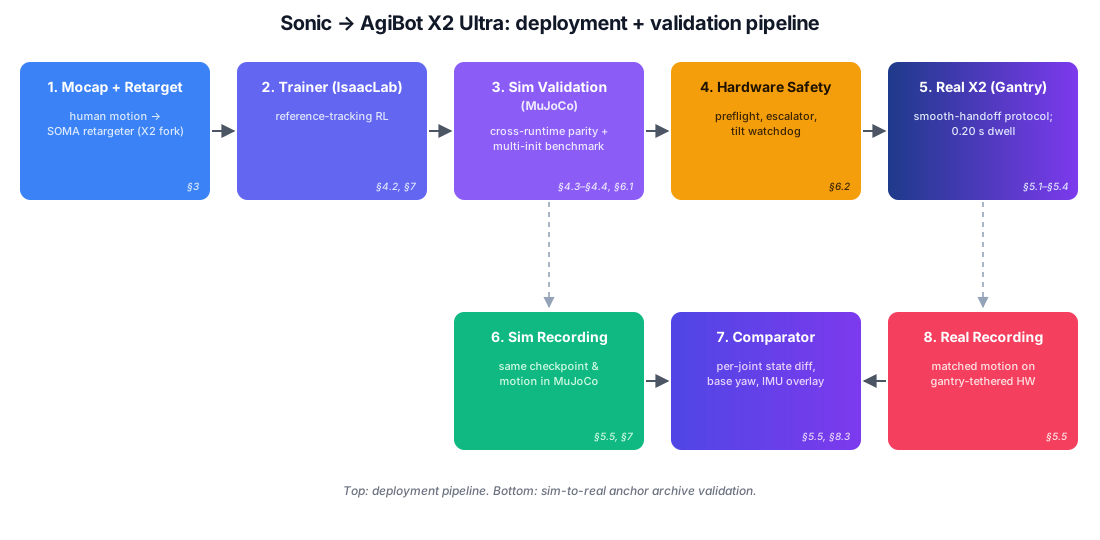
SONIC is NVIDIA's whole-body motion controller for humanoids, released with a trained policy for the Unitree G1. This project trains the same controller for the AgiBot X2 Ultra (31 DoF) and brings it to the real robot, following the same recipe as the G1 release: human motion from the BonesSeed dataset is retargeted onto the X2 body, a whole-body controller is trained on that motion library in simulation, and the trained policy is deployed on hardware through the robot's own motion controller.
The result is an X2 that can follow a wide range of reference motions — walking, dancing, gestures — and can be driven live by a person in whole-body teleoperation, with the operator's VR-captured motion streamed to the robot in real time.
Below: the pipeline from reference motion to the real robot, an evaluation of the X2 model against the stock G1 release under the SONIC paper's own criterion, and more clips on hardware.
2Pipeline
3Evaluation under the SONIC paper's criterion
Success rate (%)
| set | G1 with Stock Model | X2 Trained Model |
|---|---|---|
| novel500 (in-distribution) | 97.8 | 97.2 |
| hard300 (in-distribution tail) | 89.0 | 73.3 |
| PHUMA 1,931 (out-of-distribution) | 86.8 | 66.2 |
| Pico captures via the SMPL encoder (27) | 40.7 | 66.7 |
Tracking error (MPJPE-L, mm, successful clips only)
| set | G1 with Stock Model | X2 Trained Model |
|---|---|---|
| novel500 (in-distribution) | 26.9 | 34.3 |
| hard300 (in-distribution tail) | 35.3 | 41.5 |
| PHUMA 1,931 (out-of-distribution) | 32.8 | 43.4 |
| Pico captures via the SMPL encoder (27) | 40.4 | 42.4 |
SONIC paper criterion (arXiv 2511.07820): a clip fails if the root or an end-effector height deviates by more than 0.25 m or the root orientation by more than 1 rad; MPJPE-L is measured over the successful clips. Scored in IsaacLab. novel500 and hard300 are BonesSeed motions, PHUMA is the out-of-distribution benchmark, and the Pico row is our own VR teleop captures through the SMPL encoder.
4More demos
Two more clips on the AgiBot X2 Ultra hardware: live whole-body teleoperation, and a BonesSeed dance motion.
Whole-body teleoperation
Live whole-body teleoperation: the operator's own motion, captured with a VR headset and controllers, drives the X2 in real time through the same whole-body controller. The operator stands behind the robot; the robot follows.
Gangnam-style dance, side by side with a Unitree G1
A BonesSeed Gangnam-style dance motion, performed on hardware by the AgiBot X2 (right) and a Unitree G1 (left) side by side: arm swings, torso turns and weight shifts on both legs.
5Citation
If you find this work useful, please cite:
@misc{sonic2026agibotx2,
title = {Porting {NVIDIA} Sonic to the {AgiBot} {X2} Ultra:
A Sim-to-Sim-to-Real Bridge for a Non-{G1} Humanoid},
author = {Claude Opus and Sitarama Raju Chekuri and
Zeeshaan Mohammed and Dhruv Diddi and Samarth Shukla},
year = {2026},
howpublished = {\url{https://sonic-agibot-x2.github.io/}},
}